Energy Sphere
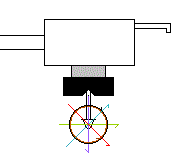
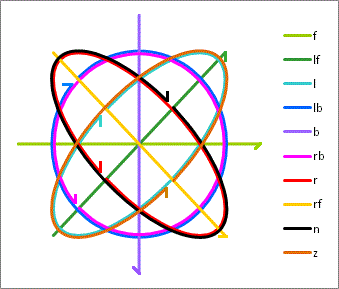
Stylus motion view from end of arm
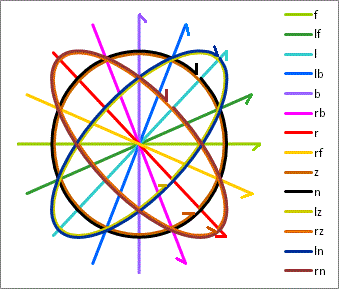
The 6 primary
stylus motions
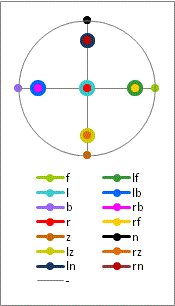
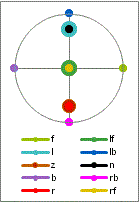
Sphere, right view
The 3 primary pairs
What is the Poincaré Energy Sphere?
The energy sphere is a convenient way to map all possible energy waves in a two-dimensional
space:
- Jules Henri Poincaré used it to describe all of the ways light can be polarized, including
circularly.
- Léon Foucault used it to describe all possible motions of a free-swinging pendulum.
- Peter Scheiber (pronounced "shee-ber", inventor of matrix quad) used it to depict all
possible stylus motions in a record groove (A phono stylus is like a tiny pendulum) and all
possible phase relationships between stereo signals. The page author independently discovered this.
I use record grooves and stereo signals. Always view stylus motions at the end of the arm (right):
- The grooves of most mono records wiggle laterally (side to side) to record sound. This is the green
spot on the sphere and the green line in the stylus motion views.
- Some early records used vertical motion (hill and dale) to record sound. This is violet
on the sphere.
- Notice that the lateral and vertical motions are perpendicular to each other (see stylus views).
Motions perpendicular to each other are called orthogonal, do not affect each other and are on opposite
sides of the sphere.
- When they designed the stereo groove, they put left and right channels at opposite 45°
motions in the record groove (stylus motion views).
- The left channel (cyan) moves it downward toward the center hole and upwards toward the rim.
- The right channel (red) moves it upward toward the center hole and downwards toward the rim.
- Note that the left channel and the right channel are also perpendicular and are on opposite
sides of the sphere. They are orthogonal.
So, in the stereo phono groove, we have four basic motions:
- Left channel (cyan)
- Right channel (red)
- Lateral (green) for mono records and sounds centered between stereo channels
- The difference between left and right channel (violet) is vertical motion.
These motions make two of the three primary orthogonal pairs on the energy sphere.
Stylus motion diagrams are also oscilloscope Lissajous patterns. Tilt your head right
45° (or tilt this paper left) to see them (vert = L, horiz = R).
Most quadraphonic recordings use lateral motions for front and vertical motions for
back sounds. The Hafler Dynaco Diamond (right) uses:
- Lateral (green) = front speaker (pair 1)
- Vertical (violet) = back speaker (pair 1)
- Left side of groove diagonal (cyan) = left speaker (pair 2)
- Right side of groove diagonal (red) = right speaker (pair 2)
- The arrowheads show positive voltage swings (or 0° phase) at the cutting head.
- Dolby Surround later used this same encoding set.
Columbia's SQ matrix design has 90° phase shifts for circular motions. Yes,
free-swinging pendulums and phono styli can move in circles:
- SQ's left back is the black clockwise circle (pair 3). Poincaré put it on top of the sphere.
- SQ's right back is the brown anticlockwise circle (pair 3). He put this on the bottom.
This is the third primary orthogonal pair on the sphere. The diagrams show all 3 primary pairs.
The remaining portions of the sphere represent linear vibrations at different angles and
elliptical motions.
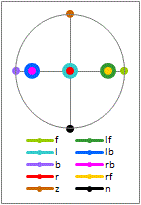
The bottom diagram is a standard right-side view of the energy sphere with the 3 primary pairs.
The right channel (red) is closest on the sphere to the viewer.
The left channel (cyan) is farthest away.
Left-side-of-the-sphere dots are larger to identify them.
Right-side dots are smaller, so they don't hide left-side dots.
Usages of various matrix systems:
Regular Matrix systems:
Regular matrix systems are based on sums and differences of various coefficients to produce
many linear decode angles.
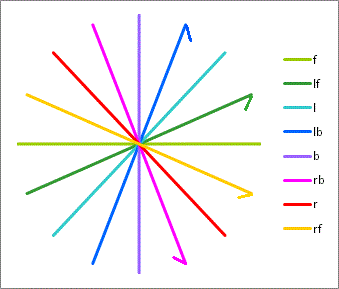
QS Stylus motions

QS Energy Sphere
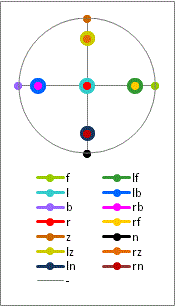
Speaker location view from right side of room
Front-oriented matrix systems
- Electro-Voice and Dynaquad have wide front angles and narrow back angles (top inset).
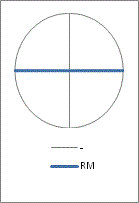
- Notice that almost all of the RM systems use only locations on the equator of the energy sphere.
These are the straight-line stylus vibrations (ignore the black and brown dots).
- The locus of all of these straight-line vibrations is shown as the blue line on the usage
sphere (which shows all parts of the energy sphere the matrix uses).
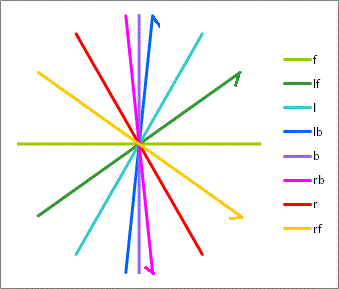
Front Oriented
Stylus motions

Energy Sphere
Usage

QS Plane
Stylus motions
Energy Sphere
Usage
Spheround
Stylus motions
Energy Sphere
Usage
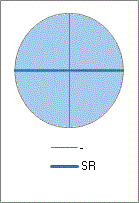
- Most RM systems use only the equator of the sphere (nothing else). So the rest of the sphere
is unused.
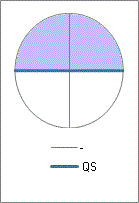
Some matrix systems have a plane of sound instead of a ring of sound (middle inset).
- The QS and Dolby Surround matrix systems phase shift the back channels to avoid an encoding phase
reversal. This makes the black clockwise circular motion when all channels get the same
signal.
- These use up half of the energy sphere, because all locations anywhere inside the
square of speakers are separate locations.
- The entire hemispherical shaded locus on the sphere is used here.
Add the author's matrix that makes a complete sphere of sound in the room (bottom inset).
- The Spheround matrix system uses circular motions in both directions to encode vertical placement
of sounds.
- The black (clockwise) motion is the nadir (down) direction.
- The brown (anticlockwise) motion is the zenith (up) direction.
- This choice of directions was made so the QS centered sounds were down near the listener and
not up in the air.
- All nadir and zenith locations use up the entire energy sphere (shaded usage).
- A room diagram for Spheround is shown to the far right. It is the same as the energy sphere,
except that up and down on the sphere are traded for the QS reason (above).
- The page author is developing this. The decoder needs no new exotic equipment. And it cannot be
patented because all patents covering its operation already existed (most by Peter Scheiber) and
have now expired. It is in the public domain.
- the page author does not expect this to become anything big, but it has two advantages:
It's fun to try (especially with an SQ record).
It's easy to do, and even to encode. No computer necessary.
More usages of various matrix systems:

SQ Position Encoder
Stylus motions

SQ Energy Sphere
Right side of room showing speaker locations
Phase Matrix systems: The Columbia SQ matrix and variants
SQ is based on using linear motion front channels and circular motion back channels:
- SQ grew out of a directive from Columbia executives that any Columbia matrix must have full
separation between the front channels in stereo and quadraphonic play.
- This meant that Columbia could not use existing matrix systems (The Hafler Diamond does fit).
- SQ produces stylus vibrations that are straight lines, circles, and ellipses.
- Notice the motions go different ways than the Regular Matrix ones go.
- SQ uses all 6 primary orthogonal points and most of the sphere, so no space for vertical pans.

SQ 4-corners
Stylus motions

Energy Sphere
(used up)
Usage

UQ & SQ 10-40
Stylus motions

Energy Sphere
(used up)
Usage
SQueround
Stylus motions
Energy Sphere
(used up)
Usage
SQ Four Corners
- The SQ 4-corners encoder (top inset) gives an encoding for the sides different than the
SQ position encoder gives (top of page).
- The 4-corners encoder was used mainly to encode discrete tapes into the SQ matrix.
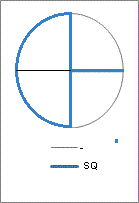
- All phase matrix systems use most of the energy sphere with various stylus motions. Useless space
is in between.
- The locus of these vibrations is shown as the blue lines on the usage
sphere.
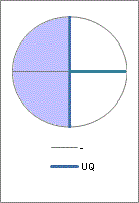
Variant versions of SQ are UQ, SQ 10-40 Blend, and EV Universal (middle inset).
- All have similar stylus motions (UQ shown).
- These use most of the energy sphere, using places near all 6 primary orthogonal points.
- Most of the hemispherical shaded locus is used, and also the front part of the equator.
- The UQ matrix corner channels (dark green, blue, magenta, and yellow) make a
regular tetrahedron on the sphere. Separation between ANY two channels is 4.77 dB.
The page author tried to make a 3-D SQ matrix sphere of sound (bottom inset). It isn't very good.
In the page author's opinion, the SQ matrix wastes more of the energy sphere without any real gain
from doing so,
Why were there so many different systems?
Each company wanted to own patent rights to the quadraphonic system that would be the standard.
No company wanted to pay patent royalties to any other company. This helped end quad.
Peter Scheiber's patent was broad enough to cover all matrix systems. No standard and royalty fights
ended quad.
This problem didn't happen with stereo because Blumlein's patents expired before stereo was popular.
Some (now esoteric) usages of various matrix systems:

UMX Stylus motions

UMX Energy Sphere
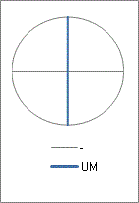
UMX Usage Sphere
Uniform Matrix systems: Denon's UMX, BBC Matrix H, and UHJ Ambisonic
The UMX system is based on using linear motions for left and right channels and circular motions for
front and back channels:
- This produces stylus vibrations that are straight lines, circles, and ellipses.
- The stylus motions go different ways than the Regular Matrix and SQ ones go.
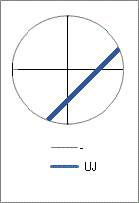
- UMX motions are on a vertical great circle of the energy sphere, instead of the RM equator
(UMX usage sphere - far right, bottom diagram).
- UMX was made to prevent the disappearance of back information in mono play.
(It was also done to try to get around patents on RM and SQ).
- Phases cause normal stereo play of the UMX encoded recording to make front sounds
(clockwise, left channel leading right) shift left, and back sounds (anticlockwise, right channel
leading left) shift right. This is called "phasiness". Decoding removes this phasiness.
BBC Matrix H

BBC Matrix H
Stylus motions

Energy Sphere
Usage

UHJ Ambisonic
Stylus motions

Energy Sphere
Usage
SpherUMX
Stylus motions
Energy Sphere
Usage
- BBC's Matrix H was devised to get rid of the mono play disappearance of back signals without
as much of phasiness problem in stereo play (above).
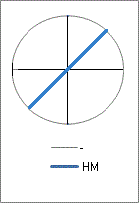
- This matrix system uses a great circle that is placed halfway between the QS equatorial plane
and the UMX vertical plane. It is at a 45 degree angle (see usage).
- The locus of all of these vibrations is shown as the blue lines on the usage
sphere.
- Matrix H can halfway (with lower front-to-back separation) play RM/QS and also UMX
recordings. Matrix H recordings play halfway on RM, QS, or UMX players.
UHJ Ambisonic
- This is a further reduction of the phasiness of stereo playback without sacrificing mono play
of back sounds.
- The phasings of this system tend to reduce the cogging problem.
- The locus of this system is not a great circle, but is concentrated on one side of the
energy sphere.
The page author designed a UMX matrix that makes a complete sphere of sound in the room
as a thought experiment (bottom inset).
- SpherUMX is like Spheround, but rotated on the energy sphere to match UMX.
- The (unused) lateral stylus motions (mono) sounds become the nadir (down) direction.
- The (unused) vertical stylus motions are the zenith (up) direction.
- This choice of directions was made to match the choices made above.
- This also has the phasiness in stereo play (above)
- No attempt has been made to use this idea. But it could work if the phasiness is ignored.
- These motions together use up the entire energy sphere.
- A room location diagram is the same (except for stylus motions) as Spheround.
- This can also be played with (the signals are much easier to get).
The page author notes that these uniform matrix variants suffer from phasiness in the stereo
image when not decoded.
Now that all of the patents have expired, we might get to enjoy some quadraphonics again.